
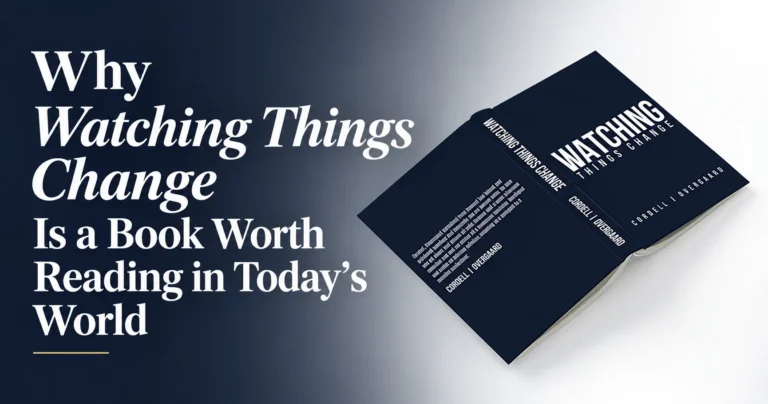
Some books entertain. Others inform. Then there are the rare books that encourage you to pause, reflect, and see the world from a completely different perspective. Watching Things Change by Cordell J. Overgaard belongs in that third category.
At first glance, it might seem like another memoir. After all, it follows the life of a man born during the Great Depression who built a successful career in law and business. But as you turn the pages, it becomes clear that this is much more than a personal story. It is a thoughtful exploration of how America has evolved over nearly a century, told by someone who experienced many of those changes firsthand.
One of the biggest reasons to read this book is its perspective. Most history books focus on major events, famous political leaders, or landmark court cases. Overgaard takes a different approach. He shows how those events influenced everyday life, professional careers, and the institutions that shape society. Instead of reading history from a distance, you experience it through the eyes of someone who lived through it.
The book begins during one of the most difficult periods in American history. Growing up during the Great Depression shaped Overgaard’s outlook on money, responsibility, and opportunity. Those early lessons stayed with him throughout his life, influencing his approach to business, investing, and decision-making. Rather than presenting these experiences as simple memories, he connects them to broader economic and political developments, helping readers understand how history often leaves lasting effects on individual lives.
Another reason this memoir stands out is the author’s remarkable professional journey. Overgaard earned an accounting degree, became a Certified Public Accountant, attended Harvard Law School, and built a distinguished career in corporate law. Along the way, he worked with major companies, participated in significant business transactions, and witnessed the legal profession evolve over several decades.
His observations about the legal industry are especially fascinating. He describes a time when law was viewed primarily as a profession built on service and ethics before gradually becoming more influenced by business pressures and financial performance. Rather than criticizing change for its own sake, he encourages readers to think carefully about what is gained and what may be lost as institutions evolve.
Politics is another area where the book offers valuable insight. Overgaard didn’t simply watch political history unfold from the sidelines. He participated in public service, worked within political circles, and observed government operations from close range. These experiences allow him to discuss political institutions with a level of nuance that is difficult to find in books written solely from an academic or journalistic perspective.
What makes these discussions engaging is that they never feel like lectures. Instead, they feel like conversations with someone who has spent decades learning from experience. Whether readers agree with every opinion is almost beside the point. The value lies in understanding how one individual interpreted the enormous changes taking place around him.
Technology also plays an important role throughout the memoir. Overgaard witnessed the transition from newspapers and radio to cable television, the internet, social media, and now artificial intelligence. Few people have experienced such a wide range of technological revolutions within a single lifetime.
Rather than treating innovation as either entirely good or entirely bad, he explores both the opportunities and the challenges it creates. His reflections on artificial intelligence are particularly timely, raising thoughtful questions about how rapidly advancing technology may influence business, law, education, and society in the years ahead.
Despite covering topics as broad as politics, economics, media, and technology, the book never loses sight of its human element. Overgaard frequently returns to values that remain important regardless of changing circumstances. Integrity, gratitude, professionalism, and adaptability appear throughout the memoir, reminding readers that while institutions may change, strong character continues to matter.
One memorable lesson is what he calls the “Charlie Davis Thank You Rule,” a simple philosophy centred on expressing gratitude and treating people with respect. It is a small idea, yet it captures one of the book’s larger messages: meaningful success is not measured only by career achievements but also by how we treat others along the way.
Readers who enjoy biographies, American history, business leadership, or legal careers will find plenty to appreciate. At the same time, the memoir remains accessible to those who simply enjoy stories about resilience, personal growth, and navigating life’s uncertainties. You do not need a legal background or deep knowledge of politics to connect with the experiences Overgaard shares.
Perhaps the greatest strength of Watching Things Change is its relevance. Although much of the memoir reflects on the past, its lessons feel remarkably current. Questions about political division, economic inequality, technological disruption, and institutional trust continue to shape public conversations today. By examining how similar challenges developed over decades, Overgaard encourages readers to think more critically about the present and more carefully about the future.
In the end, this is a book that rewards curiosity. It combines personal storytelling with historical reflection, professional insight, and thoughtful commentary on the forces that continue to shape America. More importantly, it reminds us that while change is inevitable, our ability to adapt, learn, and remain grounded in enduring values ultimately determines how we respond to it.
If you’re looking for a memoir that goes beyond one person’s life to tell a much larger story about a changing nation, Watching Things Change is well worth adding to your reading list.