
History is usually taught through dates, elections, wars, and major events. We learn who became president, when important laws were passed, and how economies rose or fell. While those facts are essential, they often leave out something equally important: what it actually felt like to live through those moments.
That is where memoirs become invaluable.
A personal memoir doesn’t replace history. Instead, it adds depth to it. It transforms events from words on a page into lived experiences, showing how national changes affected ordinary lives, careers, families, and communities. Reading history through someone’s personal journey often creates a stronger connection than simply memorising timelines.
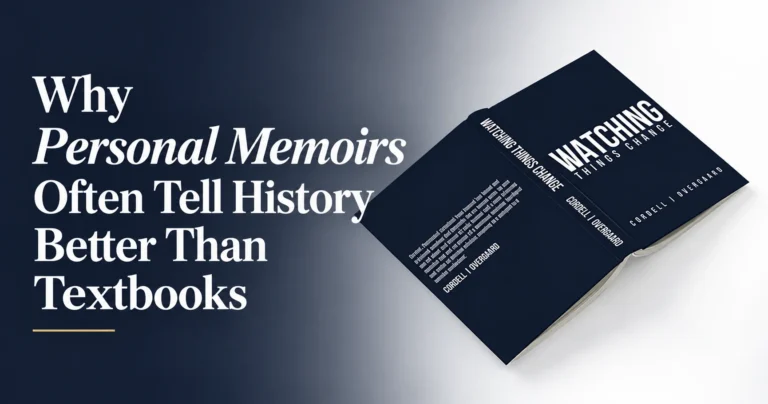
Cordell J. Overgaard’s Watching Things Change is an excellent example of this kind of storytelling. Rather than presenting history as a collection of isolated events, he shares nearly nine decades of personal experiences that intersect with some of America’s most significant political, economic, and technological transformations.
The result is a story that feels both intimate and expansive.
One of the most interesting aspects of memoirs is that they reveal how history unfolds gradually. Looking back, major events often appear inevitable. But people living through them rarely realise they are witnessing history in the making.
When Overgaard describes growing up during the Great Depression, he isn’t simply recounting an economic crisis. He’s sharing how those years influenced his family’s financial decisions, shaped his understanding of risk, and affected the values that guided him throughout his life. These personal details help readers appreciate that historical events don’t end when newspaper headlines disappear. Their influence often lasts for generations.
The same pattern continues throughout the book.
His experiences in military service, higher education, and corporate law provide more than career milestones. They illustrate how American institutions evolved over time. As industries expanded, technology advanced, and public expectations shifted, professional life changed alongside them.
This is something traditional history books don’t always capture.
They can explain when industries transformed, but they rarely show what those changes meant for the people working inside them every day.
Another reason memoirs are so valuable is that they introduce complexity. History is rarely as simple as right versus wrong or success versus failure. Personal stories remind us that change often brings opportunities alongside challenges.
Overgaard discusses the legal profession during a period when law firms were becoming larger, more competitive, and increasingly driven by financial performance. Rather than presenting these developments as entirely positive or entirely negative, he encourages readers to think about the trade-offs involved. Efficiency improved in many areas, but questions about ethics, professional identity, and long-term priorities also emerged.
That balanced perspective makes the narrative feel thoughtful rather than argumentative.
The same approach appears in his discussions of politics.
Instead of focusing only on election results or party ideologies, Overgaard reflects on how government institutions function behind the scenes. Having participated in public service himself, he offers observations based on direct experience rather than speculation. Readers gain insight into political systems while also recognising that institutions are shaped by the people working within them.
Technology provides another fascinating thread throughout the memoir.
Few generations have experienced as many technological revolutions as Overgaard’s. During his lifetime, communication evolved from newspapers and radio to television, computers, the internet, social media, and artificial intelligence.
Reading about these changes through a personal lens makes them feel remarkably different.
Rather than listing inventions chronologically, Overgaard explains how each wave of innovation changed businesses, professions, and everyday life. Readers see technology not simply as a collection of devices but as a force that continuously reshapes society.
Perhaps the greatest strength of memoirs is that they preserve perspective.
Modern conversations often focus on immediate challenges, making today’s problems seem unprecedented. Personal narratives remind us that every generation has faced uncertainty, disruption, and difficult decisions. While circumstances change, many underlying human questions remain surprisingly familiar.
How do people adapt when industries evolve?
How should institutions respond to new technologies?
What values remain important even as society changes?
These questions run throughout Watching Things Change, making the memoir feel just as relevant today as the historical events it describes.
Another quality that sets memoirs apart is authenticity.
Facts can tell us what happened, but personal experiences explain why those moments mattered. They reveal uncertainty, disappointment, ambition, resilience, and hope in ways that statistics never can.
Overgaard doesn’t present himself as someone who predicted every major change. Instead, he reflects honestly on what he learned while navigating them. That humility makes the lessons feel more genuine and more relatable.
Readers aren’t simply observing history from a distance. They’re experiencing it alongside someone who spent decades adapting to a changing world.
In many ways, that’s what makes memoirs timeless.
Long after specific political debates fade and technological trends evolve, personal stories continue to resonate because they explore universal themes. Family, career, leadership, integrity, resilience, and adaptability remain meaningful regardless of the era.
Watching Things Change reminds us that history is not only created by presidents, lawmakers, and inventors. It is also shaped by professionals, families, business leaders, and ordinary citizens whose decisions contribute to the larger story of a nation.
If you’ve ever wanted to understand American history from a more personal perspective, memoirs offer one of the most rewarding ways to do it. They bridge the gap between public events and private lives, helping readers see history not as something that happened to other people, but as something experienced one day at a time.
That is precisely what makes Watching Things Change such a compelling read. It doesn’t simply document the past. It invites readers to reflect on how change influences every generation and challenges each of us to adapt with wisdom, integrity, and perspective.