
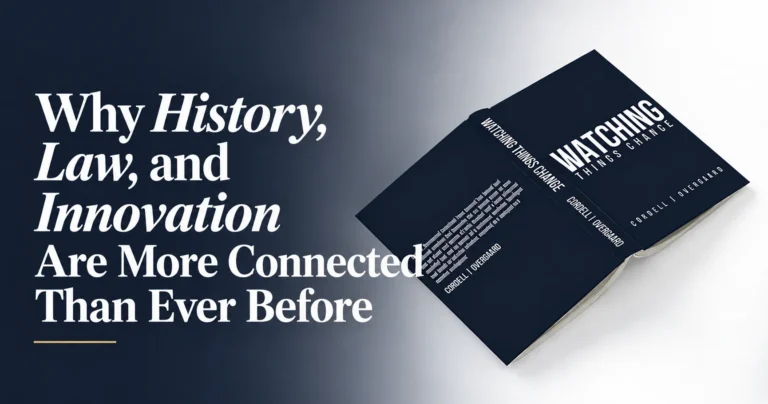
When people think about history, law, and innovation, they often picture three separate worlds. History belongs in classrooms and museums. Law belongs in courtrooms and government buildings. Innovation belongs in laboratories, technology companies, and research centres. In reality, these three forces have always been deeply connected, shaping one another in ways that influence every aspect of society.
Cordell J. Overgaard’s Watching Things Change reminds readers that understanding one without the others only tells part of the story. Through nearly nine decades of personal and professional experience, he demonstrates how historical events influence laws, how laws shape economic growth, and how innovation continually challenges institutions to evolve. His memoir is more than the story of one man’s life. It is a reflection on how America has responded to change across generations.
History has never been a series of isolated events. Every major political decision, economic crisis, technological breakthrough, or legal reform builds on what came before it. The Great Depression changed how Americans viewed financial security and the role of government. World War II accelerated industrial development and scientific innovation. The rise of global business transformed commerce and corporate law. The digital revolution reshaped communication, while artificial intelligence is now redefining how industries operate.
Overgaard lived through each of these periods, giving readers a rare opportunity to see how one lifetime intersected with many of America’s defining moments. Rather than presenting history as something distant, he shows how national events affected careers, businesses, institutions, and everyday life.
His legal career offers one of the strongest examples of these connections. As a corporate attorney, Overgaard worked with businesses navigating changing regulations, expanding markets, and increasingly complex financial systems. Every legislative change affected how companies operated. Every economic shift influenced business strategy. Every technological advancement introduced new legal questions.
This illustrates an important truth that is sometimes overlooked. Law does not simply respond to society. It also helps shape the direction society takes.
When new industries emerge, governments develop regulations. When technology advances, lawmakers must consider privacy, security, competition, and public safety. When businesses grow across international borders, legal systems evolve to support global commerce. Innovation may move quickly, but law determines how those innovations are integrated into everyday life.
That relationship has become even more important in recent years.
Artificial intelligence, for example, is transforming industries at an extraordinary pace. Businesses are using AI to improve efficiency, automate repetitive work, analyse data, and support decision-making. Healthcare providers are exploring new diagnostic tools. Financial institutions are adopting predictive technologies. Legal professionals are incorporating AI into research and document review.
Each advancement creates exciting opportunities, but it also raises difficult questions.
How should AI be regulated?
Who is responsible when automated systems make mistakes?
How can innovation continue without compromising ethics, fairness, or public trust?
These are legal questions rooted in historical experience.
Societies have faced similar challenges before whenever transformative technologies emerged. Railroads, automobiles, aviation, telecommunications, and the internet all required governments and institutions to establish new legal frameworks. Artificial intelligence is simply the latest chapter in that continuing story.
Overgaard’s memoir encourages readers to recognise that today’s debates are not entirely new. While technologies change, the need for thoughtful leadership, responsible governance, and ethical decision-making remains remarkably consistent.
The same principle applies to business.
Corporate America has experienced enormous transformation throughout Overgaard’s career. Companies have grown larger, markets have become increasingly global, and technological innovation has accelerated competition. Alongside these developments, the legal profession has evolved from a traditional service-oriented practice into an increasingly competitive business environment.
Rather than resisting change, Overgaard encourages readers to examine it carefully.
Progress often creates remarkable opportunities.
It can improve productivity, expand access to information, and drive economic growth.
At the same time, rapid change can expose weaknesses within institutions, challenge existing regulations, and create new ethical dilemmas that require careful consideration.
One of the most valuable aspects of Watching Things Change is that it avoids simplistic conclusions. The memoir does not argue that everything was better in the past, nor does it suggest that every innovation automatically improves society. Instead, it recognises that progress is most beneficial when accompanied by responsibility, accountability, and sound judgment.
This balanced perspective feels especially relevant today. Public discussions often become polarised, presenting issues as simple choices between tradition and progress or between regulation and innovation. Overgaard’s experiences suggest that meaningful progress usually requires both. Innovation drives society forward, while strong institutions provide the stability needed to manage change responsibly.
Perhaps that is why the memoir continues to resonate beyond its historical narrative. Although many of the events described took place decades ago, the questions they raise remain strikingly familiar.
How should societies respond to rapid technological change?
What role should institutions play during periods of uncertainty?
How can economic growth be balanced with fairness and public trust?
What responsibilities do professionals have as industries evolve?
These questions will likely continue shaping public conversations for generations to come.
History offers valuable perspective because it reminds us that change is inevitable. Law provides structure by helping societies manage that change. Innovation creates new possibilities that improve lives while introducing new responsibilities. Together, they form an ongoing cycle that has defined American progress for centuries.
Through his experiences in law, business, politics, and public service, Cordell J. Overgaard offers readers more than memories of the past. He provides a thoughtful framework for understanding the present and preparing for the future. Watching Things Change ultimately reminds us that while technology may transform how we live and work, it is wisdom, integrity, and adaptability that determine whether progress truly benefits society. Those timeless values remain just as important today as they were when Overgaard first began watching America change.