
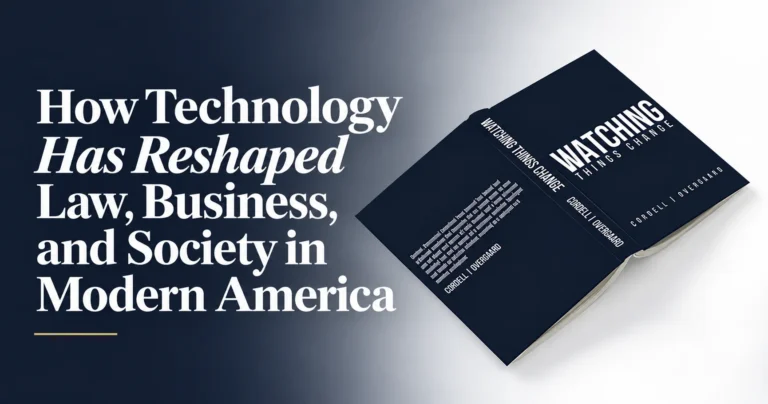
Technology has always been a driving force behind progress. It changes how we communicate, how we work, how businesses grow, and even how governments operate. While each generation experiences technological breakthroughs, few people have witnessed as many sweeping transformations as Cordell J. Overgaard.
In Watching Things Change, Overgaard reflects on a lifetime that spans nearly a century of innovation. From the era of radio and printed newspapers to today’s world of artificial intelligence, he offers a unique perspective on how technology has continuously reshaped law, business, politics, and society. His memoir isn’t a book about technology itself. Instead, it’s about the people and institutions learning to adapt as technology changes the rules.
Living Through Multiple Technological Revolutions
Most of us experience one or two major technological shifts during our lives. Overgaard witnessed several.
He grew up in a world where newspapers were the primary source of information, radio connected communities, and television was still emerging. Over the decades, he watched computers enter workplaces, the internet redefine communication, smartphones transform everyday life, and artificial intelligence begin changing entire industries.
Each innovation solved problems while creating new ones. More importantly, every advancement forced businesses and institutions to rethink how they operated.
That long-term perspective gives readers something today’s headlines often cannot: context.
Technology Doesn’t Just Change Tools. It Changes Industries.
One of the strongest messages throughout Watching Things Change is that technological innovation rarely affects just one area of society.
A single breakthrough often creates ripple effects across multiple industries.
For example:
- New communication technologies changed how businesses reached customers.
- Digital platforms transformed journalism and media.
- Automation increased efficiency while changing workforce demands.
- Data and software altered decision-making across industries.
- Artificial intelligence is beginning to reshape professional services, including law.
Technology isn’t simply about faster computers or smarter software. It’s about changing the way people work, think, and interact.
Watching the Media Transform
One area where Overgaard had firsthand experience was the media industry.
His involvement with FM radio stations, cable television, newspaper companies, and United Press International allowed him to observe dramatic changes from inside the industry.
Traditional newspapers once controlled the flow of information.
Radio connected local communities.
Television expanded national audiences.
Then came the internet.
Suddenly, information became available instantly, audiences fragmented, and entirely new business models emerged.
Overgaard’s experiences illustrate how quickly established industries can change when new technologies arrive. Businesses that once seemed permanent suddenly faced entirely different competitive landscapes.
It serves as a reminder that no industry is immune to disruption.
Technology Has Changed the Legal Profession
As a corporate lawyer, Overgaard also experienced technology’s impact on legal practice.
Legal research that once required hours in libraries gradually became digital.
Communication with clients became faster and more efficient.
Corporate transactions became increasingly complex as businesses expanded globally.
Today, technology is transforming the legal profession once again.
Artificial intelligence is assisting with document review, legal research, contract analysis, and case preparation. While these tools improve efficiency, they also raise important questions about ethics, professional responsibility, and the future role of lawyers.
Overgaard doesn’t present technology as something to fear.
Instead, he encourages thoughtful adaptation.
Progress should improve people’s lives without losing sight of the values that define responsible professional practice.
Every Generation Faces New Challenges
One interesting observation throughout the memoir is that technological disruption isn’t unique to today’s world.
Each generation experiences innovations that seem revolutionary at the time.
For previous generations, it was automobiles.
Then commercial aviation.
Television.
Computers.
The internet.
Today, artificial intelligence has become the next major transformation.
Although the technologies differ, the underlying challenge remains remarkably similar.
People must learn.
Businesses must adapt.
Institutions must evolve.
Those unwilling to change often struggle to remain relevant.
Artificial Intelligence Is the Next Turning Point
Among all the technological developments Overgaard has witnessed, artificial intelligence stands out as one of the most significant.
Unlike earlier innovations that transformed individual industries, AI has the potential to influence nearly every profession simultaneously.
- Healthcare.
- Education.
- Finance.
- Manufacturing.
- Government.
- Law.
- Business.
Its impact reaches far beyond automation.
Artificial intelligence is changing how decisions are made, how information is processed, and how organisations solve problems.
At the same time, these advances introduce new questions about accountability, ethics, privacy, and regulation.
For Overgaard, this reflects a familiar pattern.
Innovation creates opportunity, but it also demands responsible leadership.
Why Adaptability Matters More Than Ever
Perhaps the most important lesson in Watching Things Change isn’t about technology itself.
It’s about adaptability.
Throughout his career, Overgaard repeatedly encountered industries undergoing transformation.
Rather than resisting change, he learned to understand it.
That mindset remains valuable today.
Professionals across every field will continue facing new technologies, changing markets, and evolving workplace expectations.
Success depends not on predicting every innovation but on remaining curious, flexible, and willing to learn.
Looking Ahead Without Forgetting the Past
Technology will continue advancing.
Artificial intelligence will become more capable.
Businesses will evolve.
Entire industries may look very different a decade from now.
Yet history suggests that while technology changes rapidly, the principles that guide successful individuals remain remarkably consistent.
Integrity.
Critical thinking.
Professional responsibility.
Adaptability.
Lifelong learning.
These qualities enabled Overgaard to navigate nearly ninety years of extraordinary change, and they remain just as relevant for future generations.
Watching Things Change reminds readers that technology shapes the world around us, but it is ultimately people, not machines, who determine how those innovations are used. By understanding the past and approaching the future with thoughtful curiosity, we can embrace progress while preserving the values that matter most.