
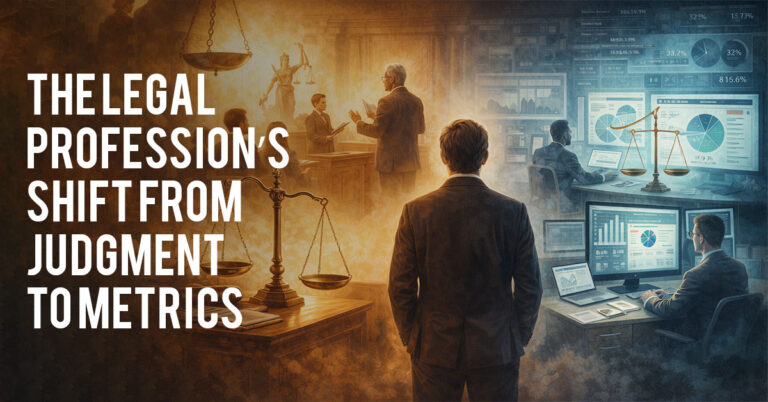
Law as a Calling
For much of its history, law was understood as a profession rather than a business. Lawyers were trusted advisors, expected to balance advocacy with ethical responsibility. Success was measured not only by income, but by reputation, discretion, and service.
Law firms functioned as professional communities. Mentorship mattered. Judgment was valued. The practice of law demanded patience, interpretation, and restraint. While competition existed, it did not dominate the profession’s identity.
Clients sought counsel, not transactions. Legal solutions were crafted with long-term consequences in mind. The profession understood that its legitimacy depended on public trust.
The Rise of Billable Culture
This balance shifted as law firms expanded and adopted corporate business models. Growth became a priority. Billable hours emerged as the primary metric of value. Time, rather than judgment, became currency.
The consequences were profound. Lawyers learned early that productivity mattered more than insight. Efficiency gave way to volume. Documentation replaced deliberation. The pressure to bill reshaped behavior at every level.
Mentorship declined as senior lawyers focused on revenue generation. Collegiality weakened. Ethical tension increased as incentives rewarded activity rather than resolution. Clients, meanwhile, questioned escalating fees while receiving increasingly fragmented service.
The profession adapted, but not without cost.
Technology and the Acceleration of Practice
Technology intensified these trends. Email, digital research, and automation increased expectations for speed and output. Tasks that once required reflection could be completed instantly, creating pressure to bill more rather than think better.
Artificial intelligence now promises further efficiency. While these tools offer genuine benefits, they also risk reinforcing the metric-driven culture. When speed becomes the primary value, judgment becomes secondary.
Law cannot function effectively without judgment. Legal outcomes shape lives, institutions, and precedents. Algorithms can assist analysis, but they cannot weigh fairness, equity, or ethical consequence.
Reclaiming Professional Identity
The future of law will involve continued technological and economic change. The challenge lies in reclaiming balance. Metrics are useful, but they cannot define purpose. Efficiency matters, but it cannot replace wisdom.
The profession must remember that its authority derives from trust. Clients, courts, and society rely on lawyers to exercise independent judgment, not merely technical skill.
Watching the legal profession change reveals a broader lesson about institutions: when systems reward numbers over values, outcomes follow. Restoring professionalism requires conscious effort—by firms, individuals, and the profession as a whole.
Law’s enduring strength lies not in efficiency, but in judgment. Without it, the profession risks losing not only credibility, but its reason for existing