
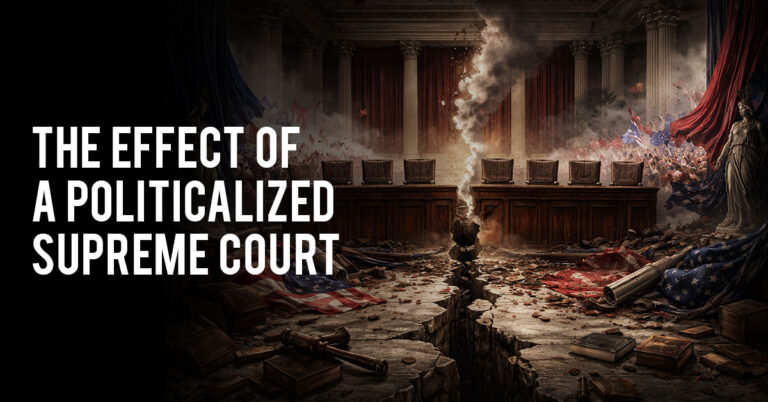
The Supreme Court was designed to stand apart from politics, serving as a stabilizing force guided by constitutional interpretation rather than ideological allegiance. Its authority rests not on enforcement power, but on public trust, the belief that decisions are grounded in law, not partisanship. When that trust weakens, the consequences extend far beyond individual rulings.
Historically, the Court was not immune to controversy, but it maintained a reputation for institutional restraint. Decisions were often nuanced, reflecting legal reasoning rather than political alignment. While critics existed, the Court’s legitimacy remained largely intact.
Over time, that perception changed. Judicial appointments became increasingly politicized, framed as ideological victories rather than qualifications-based selections. Confirmation hearings evolved into partisan theater. Court decisions began to be interpreted less as legal judgments and more as political outcomes.
Campaign finance rulings amplified the issue. Money gained greater influence over political processes, reinforcing public skepticism about fairness and representation. As Court decisions increasingly aligned with predictable ideological divisions, confidence in neutrality declined.
The effects are profound. When the judiciary is viewed as partisan, respect for rulings diminishes. Citizens begin to question not just outcomes, but the system itself. The Court’s role as an impartial arbiter weakens, replaced by perceptions of a power struggle.
This erosion of trust affects governance broadly. Legislatures defer responsibility, assuming courts will decide contentious issues. Citizens lose faith in democratic processes, viewing them as rigged or inaccessible. Polarization deepens.
The danger of a politicized Supreme Court lies not only in specific decisions, but in the precedent it sets for institutional credibility. Courts function effectively only when they are accepted as legitimate, even by those who disagree with their outcomes.
Restoring trust requires restraint, transparency, and a commitment to constitutional interpretation rather than ideological dominance. The Court cannot control public reaction, but it can control its process, tone, and respect for institutional balance.
Watching this transformation unfold underscores a sobering truth: institutions survive on trust. Once politicization overwhelms legitimacy, recovery becomes difficult. The health of democracy depends not on unanimity, but on confidence in fair process.