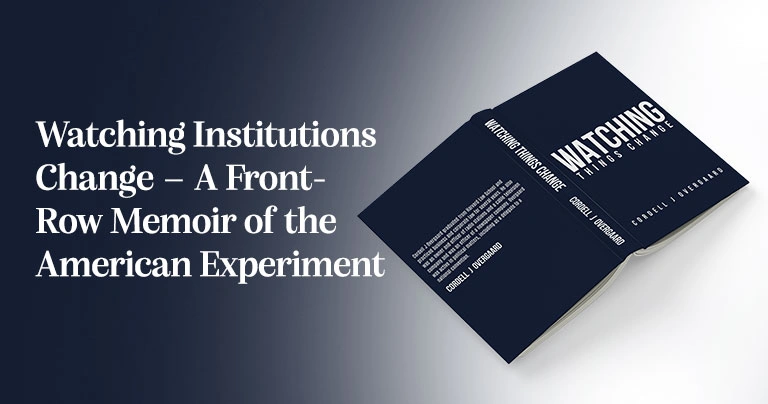
When we think of American political history, we often envision presidents, landmark legislation, and headline-grabbing scandals. Rarely do we consider how corporate law and the private sector intersect with politics, shaping the country in subtle yet profound ways. Cordell J. Overgaard’s reflective memoir, Watching Things Change, offers a compelling bridge between the personal and the political, presenting an American political history through the lens of a distinguished corporate lawyer’s life. In doing so, the book illuminates not only the evolution of law but also the transformation of society, business, and governance over nearly a century.
Early Foundations: Depression-Era America and Formative Lessons
Overgaard was born in 1934, at the height of the Great Depression, a period that left an indelible mark on his worldview. The economic collapse of 1929 and the subsequent New Deal policies of Franklin D. Roosevelt provided the backdrop for his formative years. These early experiences instilled in him a cautious approach to financial risk, a respect for hard work, and a disciplined sense of ambition. His Danish immigrant father, a meticulous house painter, and politically engaged family members further shaped his understanding of civic duty, social responsibility, and the interplay between politics and daily life.
By witnessing political debates at home and the economic struggles surrounding him, Overgaard developed a keen sense of observation. This dual focus on family influence and national events laid the groundwork for what would become both a law career and a detailed commentary on American political history.
Education and Military Service: A Preparation for Legal and Civic Life
Following high school in Chicago, Overgaard initially enrolled at the Coast Guard Academy but soon recognized that this path would delay his ultimate goal: law school. He shifted to the University of Illinois and later joined the Army during the interlude between the Korean and Vietnam Wars. While his military service did not involve combat, it provided rigorous training, administrative responsibility, and firsthand insight into the functioning of large institutions, a theme that would later resonate throughout his corporate and political analysis.
The destruction of his military records in the 1973 National Personnel Records Center fire became symbolic of a recurring motif in his memoir: the fragility and impermanence of institutions. Despite these setbacks, he completed his accounting degree, passed the CPA exam, and gained entry to Harvard Law School with a scholarship, an accomplishment that marked the start of a remarkable law career life story.
Harvard Law School: Intellectual Growth Amidst Political Awareness
At Harvard Law School, Overgaard encountered intense academic competition, the Socratic method, and personal challenges, including bouts of depression during his first year. Yet he emerged as a top student, securing a position on the Harvard Law Review and forming connections with classmates who would become prominent figures in American politics and law, such as Antonin Scalia and Michael Dukakis.
His time at Harvard was more than a legal education; it was an immersion in the currents of political thought, debate, and national decision-making. The law, in his experience, was inseparable from political life, especially when applied in corporate contexts that often intersected with governance, regulation, and public policy.
Corporate Law and Politics: A Career Intertwined with History
Overgaard’s professional life exemplifies the intertwining of law, business, and American political history. Joining the Chicago firm Hopkins & Sutter, he specialized in corporate law, mergers, and tax matters, working with influential corporations including Consolidated Foods (later Sara Lee) and Cahners Publishing.
Through this career, Overgaard witnessed the transformation of the legal profession from an ethical calling to a profit-driven business. He observed the rise of billable-hour pressures, the publication of partner incomes in The American Lawyer, and the collapse of high-profile firms like Finley Kumble, stories that reflected the moral and economic pressures reshaping law and society. These experiences provided him with a unique vantage point to comment on how corporate law intersects with political decision-making and regulatory frameworks, offering readers a nonfiction book on modern America that is both personal and historically informative.
Media Ventures and Institutional Change
Overgaard’s engagement extended beyond law into media ventures, including FM radio stations, cable television enterprises, and newspaper management. His involvement with United Press International further exposed him to the evolving relationship between media, politics, and public perception.
Through these experiences, he observed technological disruptions, shifts in economic power, and the transformation of social influence. From print dominance to the rise of digital platforms, Overgaard demonstrates that technological innovation not only reshapes businesses but also alters the political landscape, impacting public opinion and regulatory responses. This integration of media and corporate insight enriches the reader’s understanding of the American history personal account.
Political Engagement: From Local to National Influence
Overgaard did not limit his influence to the courtroom or boardroom. He actively participated in Republican politics, serving as a delegate to a national convention, chairman of a State Ethics Commission, and a political advance organizer during the Nixon and Ford administrations.
These roles provided him with insider perspectives on political operations, strategy, and the challenges of governance. Overgaard critiques structural weaknesses, polarization, and legislative inefficiencies, offering a rare viewpoint on American political history grounded in direct experience rather than secondary observation. His political engagement illustrates how the private sector, law, and personal agency intersect to influence policy and public outcomes.
Judicial Reflections and the Supreme Court
A significant portion of the memoir examines the U.S. Supreme Court and its evolution. Overgaard evaluates landmark justices, judicial philosophies, and decisions he perceives as detrimental to democratic balance. His analysis situates law and politics within a broader context, showing how legal interpretations, political pressures, and institutional evolution shape the trajectory of American governance.
This reflection emphasizes the interconnectedness of corporate law, public policy, and judicial interpretation, revealing how individual legal careers can provide insight into the broader arc of national history.
Health Care, Personal Tragedy, and Societal Observations
Overgaard also delves into his experiences with the health care system, particularly with HMOs, highlighting bureaucratic inefficiencies and structural challenges. Personal tragedy, such as his involvement in the Steve Small kidnapping case, underscores the unpredictability of life and the ethical complexities faced by individuals in high-stakes environments.
These chapters extend the memoir beyond a corporate lawyer memoir or law career life story into a meditation on societal resilience, moral responsibility, and the consequences of institutional decisions.
Global Perspective and Technological Change
In later chapters, Overgaard explores global shifts, including China’s rise, the influence of social media, and the transformative potential of Artificial Intelligence. He emphasizes that these forces will reshape law, business, and politics more dramatically than past technological revolutions.
By connecting domestic experiences with international and technological contexts, Overgaard reinforces the memoir’s central argument: understanding American political history requires attention to institutional evolution, corporate influence, and technological change.
Inequality, Adaptability, and Timeless Lessons
Throughout the memoir, Overgaard returns to themes rooted in the Great Depression: economic inequality, the fragility of institutions, and the moral challenges of professional life. He cautions that modern disparities echo historical conditions preceding the 1929 crash, stressing the need for vigilance and reform.
Overgaard advocates for adaptability as the key to survival in a rapidly changing world. He emphasizes politeness and gratitude, embodied in the “Charlie Davis Thank You Rule”, as timeless virtues that sustain relationships, careers, and social cohesion. These lessons bridge the personal and political, offering readers a blueprint for navigating both professional challenges and societal upheaval.
Conclusion: A Memoir as Historical Lens
Watching Things Change is more than a corporate lawyer memoir; it is an American political history told through the experiences of one individual navigating law, media, and politics. Overgaard’s life story illustrates how professional careers can intersect with national events, shaping and reflecting broader societal trends.
By combining personal experience with analysis of law, corporate influence, media, and governance, Overgaard provides readers with a nonfiction book on modern America that is both intimate and historically significant. His insights underscore that understanding the past and preparing for the future requires attention to the interplay between institutions, technological innovation, and human adaptability.
For anyone interested in law, politics, or the forces that shape American society, this memoir offers a rare, first-hand account of how one life can reflect nearly a century of change. Overgaard’s story reminds us that personal choices, professional paths, and ethical considerations are inseparable from the political and historical currents of our time.
Frequently Asked Questions
Watching Things Change is a memoir by Cordell J. Overgaard that blends personal experiences with analysis of law, business, media, and politics, offering a unique perspective on American political history.
Overgaard’s corporate law career exposed him to legal, regulatory, and business developments that intersect with political decisions. His experiences show how law, media, and governance shape and reflect broader societal trends.
This book is ideal for readers interested in American political history, law, business, media, and anyone curious about how professional careers provide insights into national and historical developments.
Yes, it is a detailed nonfiction book on modern America, combining Overgaard’s personal narrative with commentary on political, technological, and economic change from the 1930s to the present.
Overgaard emphasizes that change is constant and accelerating. The memoir encourages readers to remain adaptable, maintain ethical standards, and practice gratitude, principles that help navigate personal and professional challenges.