
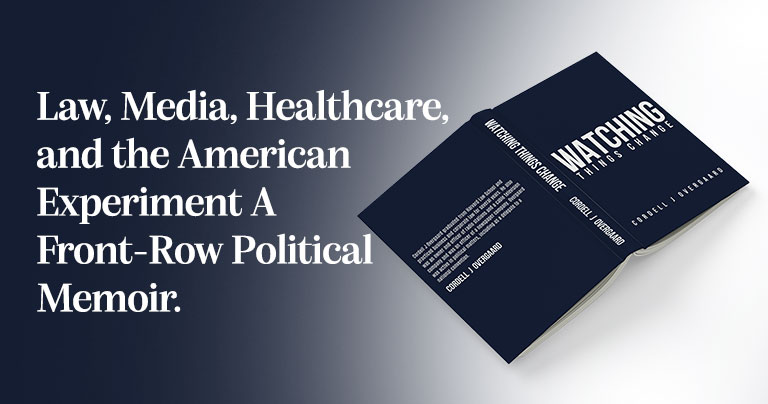
Every generation believes it is living through unprecedented change. Yet the true measure of history is not found in headlines; it is revealed through lived experience. In Watching Things Change: A Memoir by Cordell J. Overgaard, this political memoir examines modern America through the intertwined forces of law, media, and institutional power.
From courtroom battles and boardroom negotiations to the evolution of radio, television, and digital technology, the narrative reflects a nation constantly redefining itself. Through personal observation and professional involvement, Overgaard’s account becomes more than recollection, it becomes a lens for understanding how America arrived at its current political and cultural crossroads.
Growing Up in a Transforming America
Modern America did not emerge overnight. It evolved through economic upheavals, global wars, shifting social norms, and constitutional debates that reshaped institutions. To understand law and power, one must first understand the country’s transformation across decades.
The mid-twentieth century fostered faith in institutions, courts, legislatures, newspapers, and corporations were viewed as stabilizing pillars. Yet beneath that stability, deeper tensions brewed: questions of civil rights, federal authority, economic disparity, and media influence.
A memoir of American change captures this long arc. It reflects how communities shifted from local newspaper dominance to 24-hour cable commentary, from trusted civic leadership to increasing political polarization. What once felt permanent gradually revealed itself as transitional.
Law as the Framework of Power
Law is not merely a profession, it is architecture. It builds the structure within which society operates. Court decisions influence business models, media operations, healthcare systems, and electoral outcomes.
In this narrative, law functions as both shield and sword. It protects constitutional liberties while simultaneously defining their limits. Through decades inside legal practice, the evolution of corporate governance, regulatory frameworks, and constitutional interpretation became visible in real time.
A political memoir is uniquely positioned to reveal how legal theory translates into practical consequence. Judicial philosophies debated in academic circles ultimately shape everyday realities—taxation, speech, corporate consolidation, and technological regulation.
As the judiciary evolved, so too did the broader understanding of constitutional interpretation. Debates about original intent versus evolving standards were not abstract arguments; they were ideological fault lines influencing national direction.
Media: From Gatekeeper to Megaphone
No analysis of modern America can ignore the transformation of media. Once limited to print and radio, media expanded into television networks and eventually digital ecosystems that reshaped information consumption.
In earlier decades, editorial boards held significant influence over political discourse. Journalists functioned as gatekeepers. Investigative reporting shaped public trust and institutional accountability. Over time, however, technological advances shifted authority away from centralized outlets toward fragmented platforms.
This evolution altered political power dynamics. Campaign strategies adapted to television optics. Later, they recalibrated for digital immediacy. The media industry’s transformation created new opportunities for public engagement while amplifying ideological division.
Within this context, law and media intertwined. Regulatory agencies grappled with broadcast standards, ownership limitations, and antitrust enforcement. The boundaries between corporate influence and public service became increasingly contested.
Corporate America and Legal Culture
Behind political headlines lies another arena of power: corporate law. Boardrooms and law firms quietly influence regulatory policy, economic expansion, and global strategy.
A career within large-scale legal institutions reveals how decisions are shaped not solely by ideology but by incentives. Billable hours, mergers, and expanding client portfolios redefine priorities. Law firm culture evolved from collegial mentorship models to competitive corporate structures mirroring the businesses they serve.
The corporate lawyer becomes both observer and participant in national change. Regulatory reforms, financial crises, and international trade agreements all pass through legal analysis before becoming operational reality.
This insider perspective elevates an American memoir nonfiction narrative beyond personal anecdote. It situates lived experience within structural systems that drive national transformation.
The Judiciary and Political Identity
Over time, the judiciary emerged as a central arena for ideological conflict. Landmark cases influenced campaign finance, civil liberties, and economic regulation. Public awareness of Supreme Court deliberations intensified, turning legal reasoning into mainstream political conversation.
The intersection of judicial philosophy and electoral politics reshaped the national mood. Court appointments became headline news. Constitutional interpretation shifted from scholarly debate to public spectacle.
In reflecting upon this transformation, the memoir becomes both historical documentation and interpretive analysis. The courtroom, once perceived as insulated from partisan identity, increasingly reflected broader political divisions.
This shift reinforces why a political memoir United States context matters. The personal intersects with the institutional. Individual career moments become windows into constitutional turning points.
Technology and the Recalibration of Power
Perhaps the most profound transformation of modern America has been technological acceleration. From radio waves to artificial intelligence, innovation consistently reorders societal structures.
Early broadcasting expanded national cohesion. Television amplified political messaging. Digital networks disrupted information hierarchies. Each technological leap forced legal adaptation.
Technology does not simply introduce new tools, it alters power distribution. Corporate concentration grows through digital scalability. Political campaigns become data-driven operations. Public opinion shifts in response to algorithmic exposure.
Law, media, and technology form a triangular relationship. Regulatory frameworks lag innovation. Courts attempt to interpret constitutional protections within digital realities never imagined by earlier generations.
This interplay exemplifies why modern American history cannot be understood in isolation. The forces shaping democracy operate simultaneously across institutions.
Power, Inequality, and Public Trust
With change comes consequence. Economic disparities widened. Public trust in institutions fluctuated. The distance between political rhetoric and lived experience became more visible.
Legal reforms aimed at fairness sometimes produced unintended outcomes. Media expansion empowered voices while amplifying extremism. Corporate growth generated prosperity alongside inequality.
A reflective memoir does not claim omniscience; it acknowledges complexity. Power is rarely static. It shifts between institutions, economic sectors, and public sentiment.
Through decades of professional engagement and civic observation, patterns emerge: institutional resilience, cycles of reform, and recurring debates over constitutional meaning.
The Human Dimension of Political History
Statistics cannot capture the lived reality of institutional change. Only narrative can reveal how policies affect careers, communities, and families.
Personal recollections illuminate broader trends. Conversations in law offices reflect shifts in corporate governance. Editorial meetings mirror cultural tensions. Judicial opinions reveal evolving national identity.
A thought-provoking nonfiction politics work challenges readers to see beyond headlines. It invites examination of how systems operate beneath surface narratives.
The memoir format provides continuity. It connects generational memory with structural analysis. Through lived experience, abstract political theory becomes tangible.
Lessons from Decades of Observation
Looking back across modern American history reveals both fragility and endurance. Institutions bend under pressure yet often adapt rather than collapse. Political polarization intensifies yet constitutional frameworks persist.
Several enduring themes emerge:
- Law remains the primary instrument through which societal change becomes institutionalized.
- Media shapes perception as powerfully as legislation shapes policy.
- Technology accelerates both innovation and disruption.
- Corporate structures influence political realities more profoundly than most citizens recognize.
- The convergence of these elements defines modern America’s trajectory.
Why Political Memoir Matters Today
In an era dominated by rapid commentary and digital sound bites, long-form reflection carries unique value. A political memoir provides context where social media provides reaction. It emphasizes continuity where headlines emphasize crisis.
By weaving together law, media evolution, and institutional transformation, such a narrative offers readers perspective rather than partisanship. It documents not merely events, but patterns.
Modern America did not arrive at its present state by accident. It was shaped by decisions in courtrooms, corporate boardrooms, legislative chambers, and media studios. Personal witness to these arenas enriches historical understanding.
The power of memoir lies in its dual function: storytelling and interpretation. It records experience while inviting analysis.
Sums Up
Law, media, and power form the foundation of modern American life. Their interaction determines how citizens vote, how businesses operate, and how rights are defined.
This political memoir captures decades of transformation, an America evolving from institutional stability to technological acceleration, from broadcast consensus to digital fragmentation. It reflects both the promise and tension of democratic governance.
Through firsthand experience, professional engagement, and historical reflection, the narrative becomes more than memory. It becomes insight.
For readers seeking depth rather than slogans, context rather than commentary, and lived experience rather than abstract theory, this exploration of modern America offers enduring relevance.
Frequently Asked Questions
A political memoir offers a firsthand account of events, decisions, and institutional change, while a traditional political history book presents research-driven analysis from an external perspective. A memoir blends lived experience with historical context, giving readers insight into how legal, media, and governmental systems operate from inside the institutions themselves.
Law shapes political power by defining constitutional limits, regulatory structures, corporate governance, and civil liberties. Court decisions and legislative reforms directly impact media ownership, economic policy, healthcare systems, and technological innovation, making the legal system a central force in shaping modern America.
Media determines how information is distributed, interpreted, and debated. From print newspapers to digital platforms, shifts in media structure have changed campaign strategy, public opinion, and institutional accountability. Understanding media evolution helps explain today’s political polarization and public trust challenges.
Technological advancements, from broadcast radio to artificial intelligence, have forced courts and lawmakers to reinterpret constitutional protections in new contexts. Innovation often moves faster than regulation, requiring the legal system to continually adapt to emerging ethical, economic, and societal questions.
This type of memoir is ideal for readers interested in political history, legal careers, media transformation, and societal change. It is especially valuable for students of government, professionals in law or journalism, and anyone seeking a deeper understanding of how institutions shape everyday American life.